
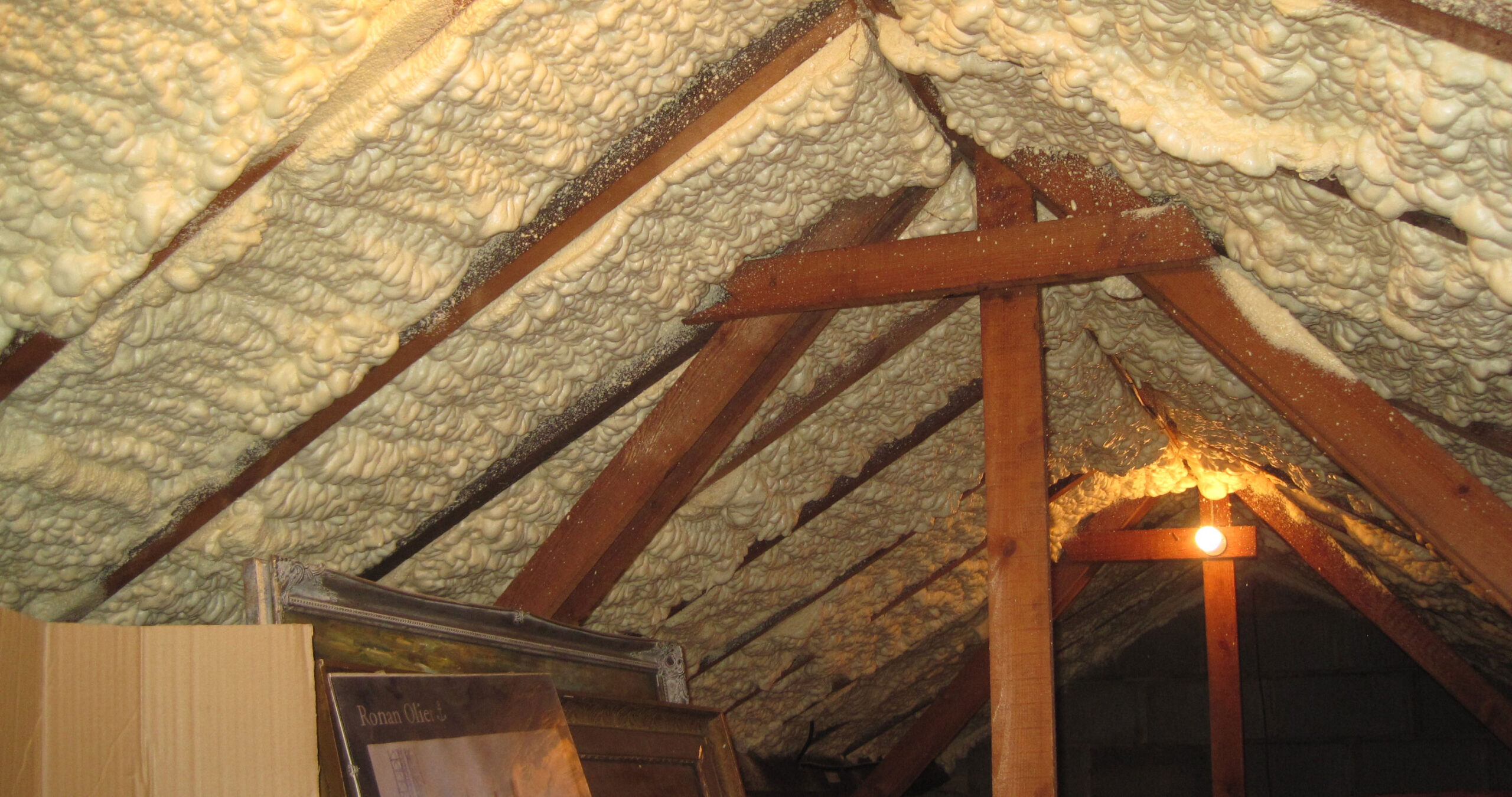
Spray Foam Insulation in a Roof Space: Removal Was Not Automatically Necessary
Brendan O’Callaghan MRICS
I was asked to attend a 1960s house to provide an experienced opinion on spray foam insulation that had been installed approximately five years earlier. The purpose was not to assume that the foam was defective, but to examine its installation, consider the risks commonly associated with spray foam in traditional roofs and establish whether there was evidence of actual harm.
At a Glance
Concern | Open-cell spray foam had been applied directly beneath the original reinforced bituminous sarking felt, restricting normal inspection and blocking the original soffit ventilation route. |
Finding | The installation was uneven and poorly finished in places, but no visible moisture damage, fungal decay, insect attack or structural deterioration was identified. |
Action | Localised foam was removed at ridge and eaves levels and at both ends of the roof space so accessible rafters could be inspected and moisture readings taken. |
Conclusion | No immediate remedial works or wholesale removal were considered necessary on the evidence available, although future monitoring, lender caution and increased re-roofing costs remain relevant. |
Why I Was Asked to Inspect
Spray foam insulation in roof spaces has attracted considerable concern because it can conceal roof timbers, restrict ventilation and complicate mortgage lending or a future sale. However, the presence of spray foam does not, by itself, establish that the roof structure is damaged or that immediate removal is justified. A defensible opinion must be based on the type of foam, the way it has been installed and, most importantly, the condition actually found.
The Roof and the Installation
The house had a simple pitched roof covered with interlocking concrete tiles. The roof lines appeared satisfactory from ground level, with no significant distortion or deflection suggestive of roof spread or loss of restraint. The spray foam was reported to be Lapolla FL-500, an open-cell product, applied to the underside of the original reinforced bituminous sarking felt.
The application was uneven and poorly executed in places, with small voids, inconsistent coverage, overspray and a variable surface finish. Foam had also obstructed the ventilated soffit route that originally served the cold roof. This workmanship fell below what would ordinarily be expected of a professionally installed system, although poor appearance alone did not prove that the roof timbers had deteriorated.
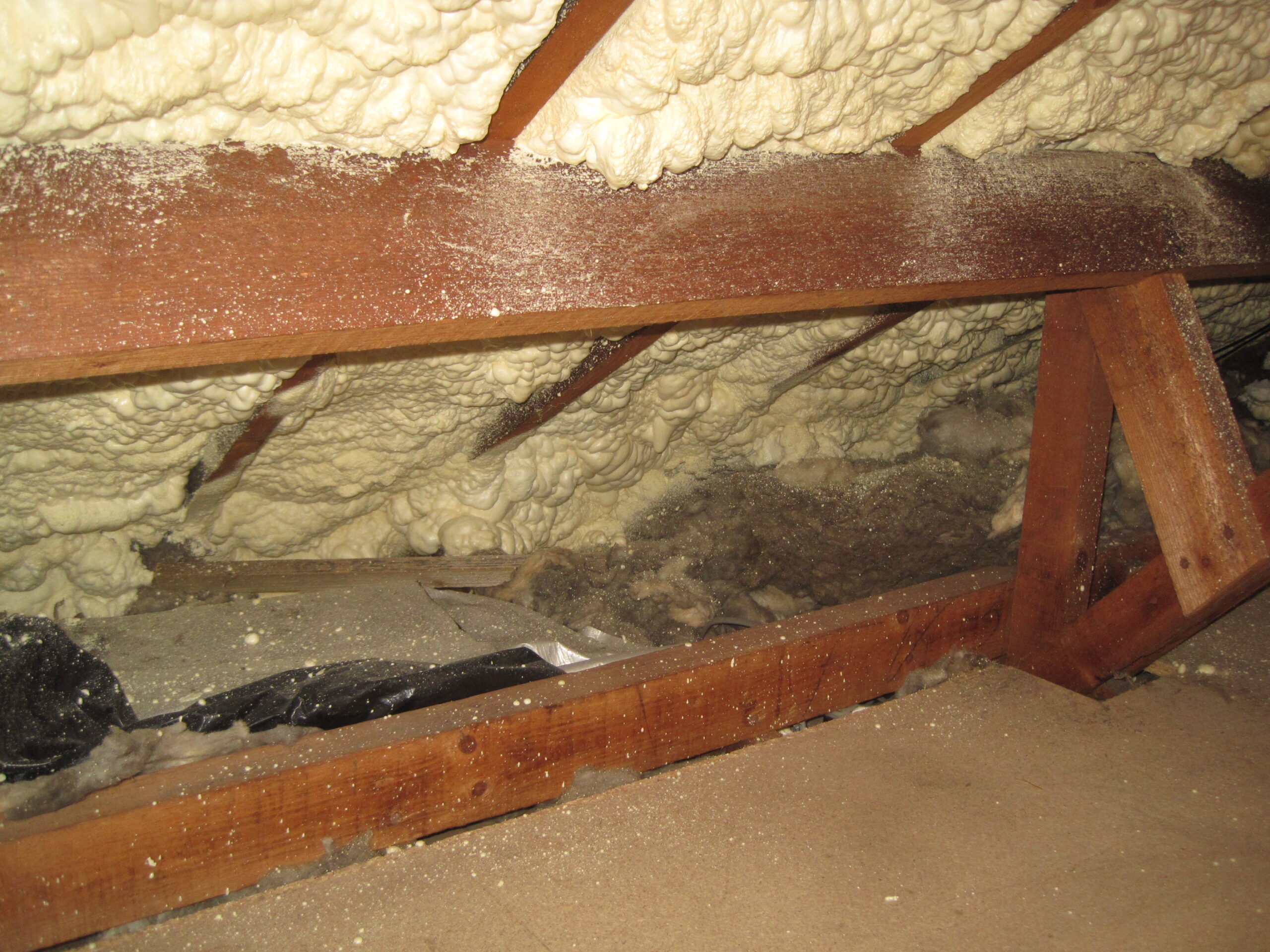
Uneven spray foam application with overspray, inconsistent coverage or foam obstructing the original soffit ventilation path.
Intrusive Checks to the Roof Timbers
A visual inspection of foam-covered rafters is inherently limited. For that reason, localised sections of foam were carefully cut away at both ridge and eaves levels and at both ends of the roof space. This allowed comparison between different orientations and provided limited access to the underlying timber.
The foam was approximately the same depth as the 75 mm rafters. The exposed timber was inspected for staining, softness, distortion, fungal growth, insect attack and other evidence of prolonged moisture. Indicative moisture readings were also taken to accessible areas. The readings were within the range normally regarded as acceptable for internal structural timber, although towards the upper end of that range. Importantly, there were no corresponding visual signs of an active moisture-related defect.
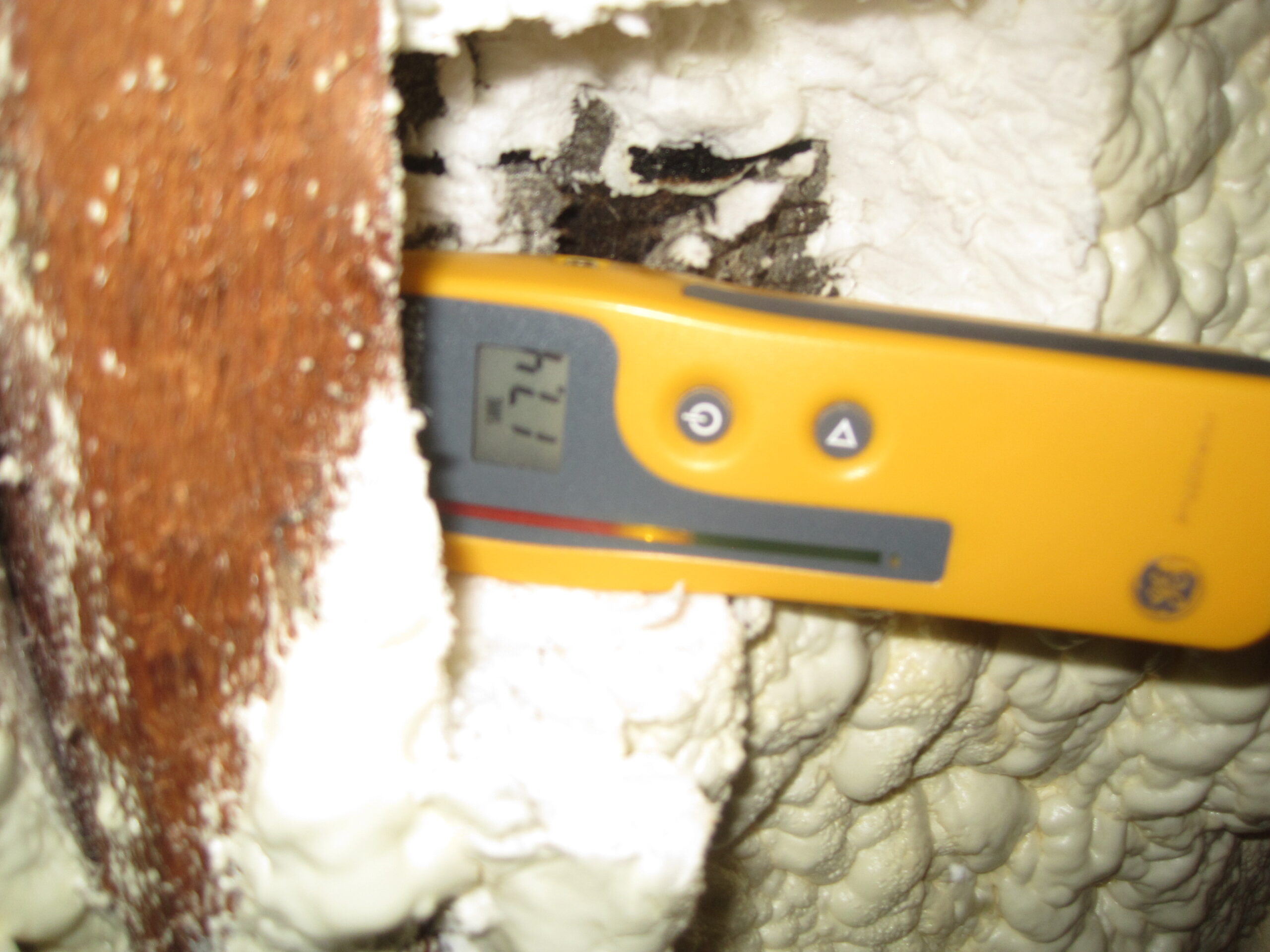
Localised intrusive inspection where spray foam was removed to expose and assess the underlying rafter at ridge or eaves level.
What the Checks Found
No evidence was found of visible water ingress, staining, mould growth, wood-destroying fungi, insect infestation or material timber deterioration. The installation had been in place for approximately five years and, at the time of inspection, no adverse moisture-related effects were apparent either to the visible roof structure or to the limited areas exposed by cutting back the foam.
The first-floor ceilings contained only limited insulation. In a traditional cold roof, this could allow warm, moisture-laden air to enter the roof space and raise condensation risk. In this instance, however, the foam also provided a degree of air sealing at roof level. Although this did not represent a conventional or ideal warm-roof construction, there was no evidence that condensation had caused damage during the period since installation.
The Continuing Limitations
The spray foam continues to restrict inspection of concealed rafters, battens, electrical cabling and the underside of the sarking felt.
The original soffit ventilation route has been blocked, which remains contrary to the roof’s original cold-roof design.
Some mortgage lenders and future purchasers may remain cautious even where no present defect is identified.
When the roof covering eventually requires renewal, foam bonded to the sarking felt is likely to complicate stripping and increase cost, disruption and health-and-safety controls.
Complete removal can be technically difficult and may leave residue or cause damage to timbers, felt and fixings. Poorly executed removal may introduce new problems rather than resolve existing ones.
What I Would Tell My Client
I would not recommend removal simply because spray foam is present. In this case, the workmanship was imperfect and the roof could no longer be inspected in the normal way, but the limited intrusive checks did not identify timber decay, fungal growth or an active moisture problem after approximately five years in service. My advice would be to retain the installation for the present, keep the roof under periodic review and recognise the likely implications for future lending, saleability and roof renewal. |
The Surveyor’s View
Spray foam insulation should be assessed on evidence rather than assumption. There are legitimate technical and market concerns, particularly where foam is bonded directly to older sarking felt and ventilation has been obstructed. Those concerns justify careful inspection and, where appropriate, selective opening-up. They do not automatically justify costly wholesale removal when the timber condition is satisfactory and no active defect is demonstrated.
In this case, no immediate remedial work was considered necessary. The balanced course was to document the limitations, monitor the roof periodically and ensure any future removal or re-roofing work is planned by suitably experienced specialists with an appropriate method statement.
Technical Note on Moisture Readings
Electronic moisture meters provide indicative readings only. Results can be influenced by timber species, surface condition, temperature, salts, metal fixings and recent weather. Readings should therefore be interpreted alongside the visible condition of the timber and surrounding materials, rather than treated as a diagnosis in isolation. In this inspection, the absence of staining, mould, decay, distortion or musty odours supported the conclusion that the readings did not represent an active moisture-related defect at that time.
Concerned about spray foam insulation in a property you own or are purchasing? A targeted inspection can help distinguish theoretical risk from evidence of actual deterioration.